Worthington Garbage Disposal Replacement Sizing Choices
Choosing the right garbage disposal size before a replacement keeps your Worthington kitchen running smoothly for years. Buy something underpowered for a busy household and you'll deal with jams, resets, and premature burnout. Buy something oversized for a single-person apartment and you're spending money on capacity you'll never use. The sizing decision comes down to a handful of practical factors: how many people live in the home, what kinds of food scraps regularly go down the drain, and how much under-sink space you're working with. Getting that match right is the whole game.
Why Horsepower Is the Starting Point for Any Disposal Sizing Decision
Garbage disposal capacity is rated in horsepower, and that single number determines what the unit can handle before it bogs down or jams. The market breaks into three practical tiers: one-third to one-half HP for light residential use, three-quarter HP for mid-range households, and one HP or above for heavy-duty grinding needs.
A half-HP unit runs well for one or two people who primarily grind soft food scraps — vegetable trimmings, cooked pasta, fruit peels. The motor isn't built for fibrous vegetables like celery, hard items like small bones, or repeated high-volume loads. Push it past its limits consistently and the thermal overload trips or the grinding components wear out faster than they should.
A three-quarter HP disposal handles a three-to-four person household comfortably. It can manage tougher scraps occasionally without struggling, and it recovers better under intermittent heavy loads. Most Worthington homes with a family of three or four will find this range hits the right balance between cost and daily performance.
One HP and above is the tier for households of five or more, serious home cooks who process large quantities of food scraps regularly, or anyone who consistently grinds harder items. These units run quieter in proportion to their power because they don't have to work as hard, and they tend to carry longer warranties because the components are built to a higher standard.
How Household Size Maps to Disposal Capacity in Real Terms
A useful rule of thumb: add roughly one-quarter HP of capacity per household member. A single person living alone in a Worthington apartment is well-served by a half-HP unit. A couple can stretch that same unit comfortably. Once you're at three people, move up to three-quarter HP. Four or more, and one HP becomes the practical baseline.
This isn't just about grinding power in isolation. Motor size also affects how quickly the disposal processes a load, how hot it runs under sustained use, and how well it handles a kitchen that's being used for back-to-back meal prep. A undersized motor running at capacity every day is going to fail earlier than one operating comfortably within its design range.
For Garbage Disposal Repair situations where the old unit has already failed, the sizing conversation becomes even more important. The replacement is an opportunity to correct a mismatch — if the original unit jammed frequently or needed resets, that's a signal it was undersized for your actual usage pattern.
Feed Type Makes a Difference When Sizing for Worthington Kitchens
Beyond horsepower, the feed type affects the practical performance experience. Continuous-feed disposals — the standard type where you flip a wall switch — are the most common in Worthington homes. They work well for households that grind scraps during and after cooking. Batch-feed disposals require a stopper to activate and process one load at a time, which suits households with young children where safety is a priority, or people who prefer a more controlled workflow.
Batch-feed models tend to run slightly quieter because the chamber is covered during operation. They're also somewhat less prone to accidental drops of silverware or debris into the grinding chamber. The tradeoff is throughput: you can't grind continuously as you prep a large meal. For high-volume kitchens, continuous-feed remains the practical choice.
If you're not sure which type the old unit was, check under the sink for a wall switch nearby. Continuous-feed units use one; batch-feed units don't. That detail also matters when planning a replacement because switching feed types may require minor electrical work.
Under-Sink Space and Plumbing Compatibility Affect What Will Physically Fit
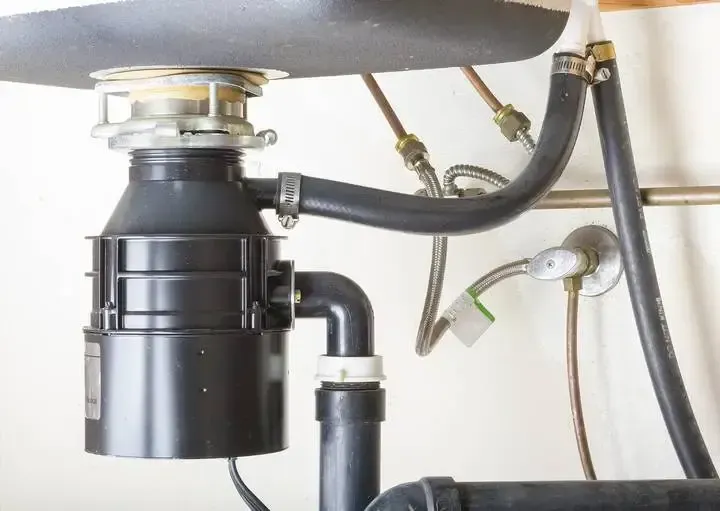
Horsepower isn't the only constraint. The physical dimensions of the unit have to work with what's already under your sink. Higher-HP models are generally taller and heavier. If your under-sink cabinet is already cramped with supply lines, a drain trap, and possibly a dishwasher connection, a bulkier unit may not fit without modification.
Most disposals use a standard three-bolt mounting system, which means replacement units from the same manufacturer typically drop in without changing the sink flange. Switching brands often means replacing the mounting hardware and possibly the drain connection. If you're staying with the same brand and similar product line, the swap is more straightforward. If you're upgrading to a different brand, budget time and possibly some additional fittings for the transition.
The dishwasher drain connection is another point to check. If your dishwasher drains into the disposal, the replacement unit needs a knockout for that connection. Most disposals include it, but it has to be punched out before installation. Missing this step during a DIY replacement is one of the most common reasons a new unit floods the cabinet on first use.
Common Sizing Mistakes That Lead to Early Replacement Failures
The most frequent mistake is replacing like-for-like without evaluating whether the original size was correct. If your half-HP unit lasted only three years in a family of four, the problem wasn't the brand — it was that the motor was working beyond its intended load constantly. Replacing it with another half-HP unit restarts that cycle.
A second common error is buying based on price alone. The cheapest unit in a category is usually at the lower end of the HP range for that price point. Over a five-to-ten year ownership window, the cost difference between a three-quarter HP and a half-HP unit is modest, but the performance and longevity gap can be significant for an active kitchen.
Third, people sometimes overlook noise insulation ratings. Higher-end models in the three-quarter to one HP range often include sound baffling that makes a meaningful difference in how loud the unit is during operation. In open-concept Worthington homes where the kitchen flows into a living or dining space, that quieter operation is worth factoring into the selection.
When to Have a Professional Handle the Sizing and Installation
If you're uncertain about what size you need, a plumber can assess your kitchen usage, check the existing electrical setup, and recommend the right unit before you purchase. This matters more than it might seem: disposal installation involves both plumbing and electrical components, and getting either wrong creates problems that can range from leaks to tripped breakers.
Worthington homes with older under-sink plumbing may also have drain configuration quirks that affect which units will work cleanly. A professional who's familiar with fixing kitchen disposals across a range of Worthington home configurations will catch those issues before the new unit is installed rather than after.
Sizing a garbage disposal correctly isn't complicated once you know what variables actually matter. Match horsepower to household size, account for your actual food scrap habits, verify physical fit before purchasing, and don't replicate a size that already proved too small. Those four steps put you in the right unit the first time.